

Private label under new responsibilities: GPSR and PPWR are changing the rules of cooperation between manufacturers and brand owners
The private label market has been developing dynamically for many years. For contract manufacturers, this creates new business opportunities, while for retail chains and brand owners, it provides an opportunity to build a competitive advantage through the development of their own product portfolios. At the same time, European regulations concerning product safety and packaging are significantly changing the rules of responsibility across the entire supply chain.
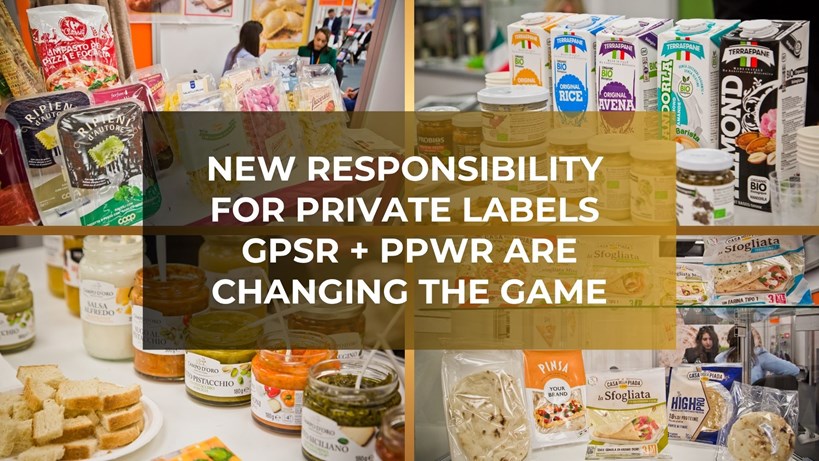
GPSR (General Product Safety Regulation) and PPWR (Packaging and Packaging Waste Regulation) change the rules for private label businesses
The GPSR (General Product Safety Regulation) concerning general product safety and the PPWR (Packaging and Packaging Waste Regulation) concerning packaging and packaging waste mean that the previous business model: “the manufacturer produces, the brand owner sells” is no longer sufficient. Increasing importance is being placed on technical documentation, risk assessment, product traceability, and a clear allocation of responsibilities between business partners.
A private label brand owner may be considered a manufacturer
One of the most important issues for the private label market is product liability. Under the GPSR requirements, a manufacturer is not only an entrepreneur who physically manufactures a product. A manufacturer may also be considered to be an entity that commissions the design or production of a product and places it on the market under its own name or trademark. In practice, this means that a private label brand owner may be subject to manufacturer obligations, even if it does not own a production facility itself and uses the services of a contract manufacturer.
This applies in particular to:
- retail chains developing their own brands,
- importers,
- distributors,
- companies creating their own product lines.
Product responsibility is therefore increasingly covering the entire process – from design, through production and quality control, to the final sale to the consumer.
GPSR – product safety requires control of the entire process
The GPSR Regulation, which has applied since 13 December 2024, introduced a new approach to consumer product safety in the European Union. The fundamental principle remains clear: only safe products may be placed on the market. The obligation to ensure product safety applies not only to physical manufacturers but also to other market participants – including importers, distributors, and entities responsible for placing products on the market under their own brand.
For companies operating under the private label model, this means the need to:
- carry out product risk assessments,
- prepare and retain technical documentation,
- ensure product traceability,
- implement product safety monitoring procedures,
- respond to reports concerning potential risks,
- cooperate with market surveillance authorities.
An important area of change also concerns online sales. GPSR increases the requirements regarding information provided to consumers before they complete a purchase.
PPWR changes the approach to packaging
The second regulation that will have a major impact on the private label market is PPWR – Regulation (EU) 2025/40 on packaging and packaging waste. The regulation will apply from 12 August 2026. The new rules cover a wide range of packaging placed on the European Union market and apply to many market participants – manufacturers, importers, distributors, and private label brand owners.
PPWR introduces new requirements concerning, among other things:
- documentation of packaging compliance,
- conformity assessments,
- restrictions on the use of certain hazardous substances, including PFAS,
- designing packaging with recyclability in mind,
- reducing excessive packaging weight and volume,
- new rules for environmental labelling and communication.
This means that packaging is no longer merely a marketing element. It has also become an area of regulatory responsibility.
12 August 2026 – an important date for the private label industry
For contract manufacturers, brand owners, and distributors, 2026 will be a period of significant change. From 12 August 2026, businesses will have to adapt their processes to the new packaging requirements, including:
- preparing appropriate documentation,
- ensuring packaging compliance with PPWR requirements,
- verifying the markings used,
- controlling environmental communication,
- defining the responsibilities of individual participants in the process.
For the private label market, it is particularly important that the brand owner determines the scope of its responsibility for packaging and cooperation with suppliers already at the product design stage.
Contract manufacturers and brand owners should cooperate from the beginning of the project
The new regulations show that compliance issues cannot be analysed only shortly before a product is placed on the market. Already at the beginning of a project, it is worth defining:
- who is responsible for technical documentation,
- who performs the risk assessment,
- who ensures product compliance with GPSR,
- who is responsible for packaging requirements,
- who organises laboratory testing,
- who manages corrective actions or potential product recalls.
A lack of a clear division of responsibilities may lead to disputes between the contract manufacturer and the brand owner and make it more difficult to demonstrate compliance during inspections.
Regulatory compliance as a competitive advantage
Adapting to GPSR and PPWR requirements should not be viewed solely as a legal obligation. Companies that prepare appropriate procedures, documentation, and compliance control processes today are building a competitive advantage. An increasing number of business partners expect suppliers not only to provide attractive prices and product quality but also transparency, safety, and confirmed regulatory compliance. For private label manufacturers, this creates an opportunity to build long-term business relationships. For brand owners, it means greater operational security and reduced risk.
GPSR and PPWR are changing the way the private label market operates
Responsibility for products and packaging no longer ends at the production stage. It covers the entire supply chain – from the contract manufacturer, through importers and distributors, to the brand owner.
Companies operating under the private label model should already ensure:
- a clear allocation of responsibilities,
- updated agreements with business partners,
- preparation of documentation,
- cooperation with packaging suppliers and laboratories,
- adaptation of processes to new requirements.